Inside the mechanism
A day on Jupiter lasts less than the time it takes to fly across Earth. A year on Jupiter is a completely different story.
- 9.9 h
- Jupiter’s approximate rotation
- 4,333 days
- One journey around the Sun
- About 11×
- Earth’s diameter
Illustrated walkthrough
See how it works
One turn around its spin axis is a Jovian day.
Original CurioWander schematic · the illustration is educational, not a scale-accurate simulation.
Interactive 3D study
Turn a textured planetary globe
The globe is a spherical reconstruction projected in three dimensions from the site’s existing planetary texture maps. The view is illustrative: no live spacecraft position, rotation timing, atmosphere dynamics or ring geometry is represented.
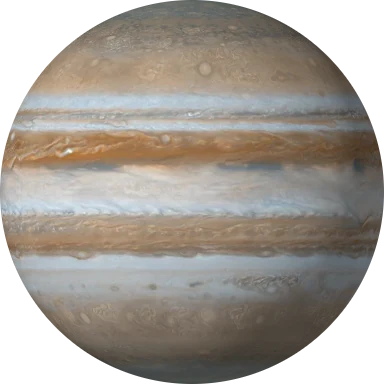
Rotate the globe with the longitude control when the interactive model is available. A still view remains available otherwise.
Two independent movements
Rotation is a planet turning about its own axis. Revolution is its journey around the Sun. The mechanisms operate on different clocks: an object may spin rapidly while following a very large orbit. Jupiter rotates in under ten hours, whereas its orbit takes almost twelve Earth years.
Why the clouds move at different speeds
Jupiter does not have a rigid outer surface like Earth. Its visible bands are moving atmospheric clouds; the planet rotates differentially, so cloud features at different latitudes can have different periods. Astronomers use radio and magnetic measurements as references for the bulk rotation.
A planet slightly wider across the middle
Spinning rapidly gives material near the equator a tendency to move outward. Combined with gravity and the planet’s fluid interior, this makes Jupiter oblate rather than a perfect sphere. This is an observable consequence of rotation, not the reason for its much longer orbital period. Jupiter’s strong gravity and weather are studied with the Juno spacecraft.
Keep exploring
Further reading: NASA: Jupiter facts